Introduction
Artificial intelligence may change the world more than any technology in history. That says nothing about who will profit from it.
This essay makes that case. AI will very likely transform the economy. The harder question, and the one that matters to an investor, is who gets paid when it does. For two hundred years, the answer has rarely been the people who built the technology.
The debate about AI and markets has settled into two camps. The first says the frontier labs are winner-take-all businesses: whoever builds the best model captures everything, and every other company becomes a customer or a casualty. The second says AI is a bubble: the spending will never earn its return, and the crash will prove it was all hype.
Both are wrong, and history shows why. The first forgets that builders rarely keep the value they create. The second forgets that a bubble can install a real revolution: railways and fiber were bubbles, and both still changed the world. This essay describes a third path. The technology is real and the transformation will be profound, but the profits will flow mostly to users, to whoever controls what stays scarce, and to investors who refuse to overpay.
I'm an investor based in Los Angeles, one of the centers of the space industry and the birthplace of SpaceX and home of Hadrian, which builds automated factories for aerospace and defense parts. Nearby, one of Hadrian's customers, Anduril, builds autonomous weapons. I see the future being built here every day. Last year I went looking for it in three other places. Each showed me a different side of the same question.
In Shanghai, I met with hard-tech venture capitalists to see the state of the art in AI, robots, and autonomous driving. I learned that the frontier labs are ahead, but the free models are close behind. A lead in intelligence is fleeting. That is the oldest pattern in technology: innovators at the bleeding edge keep only a sliver of what they create. The labs may change the world and still not be the ones who profit.
In Chile's Atacama Desert, I saw Escondido, the world's largest copper mine. Every data center, transmission line, and electric motor needs copper. I learned that finding a new deposit and bringing it into production takes a long time and commodity cycles run slowly. There is no guarantee supply can keep up with demand for the physical inputs AI needs. Slow supply is what keeps a bottleneck profitable. Intelligence is getting cheaper every year. The copper it runs on still has to be dug out of the ground. The profits from cheap intelligence may flow to whoever owns what it cannot make: the commodities, the power, the land.
In Tokyo, I studied some of the world's oldest businesses. Japan has more companies over a century old than any other country. I went to learn what makes a business endure. I learned that durability has a shadow: endurance can harden into obstinacy and intransigence, and a company that outlasted one revolution can be slow to see the next. Endurance is what an investor wants to own. Obstinacy is what turns a cheap stock into a value trap. Warren Buffett's test, which runs through this essay, is the durability of a competitive advantage. Tokyo taught me to ask whether a business endures because it adapts or because it doesn't need to. AI will put that question to every franchise built when thinking was expensive.
Those three trips are this whitepaper in miniature. Each answers part of the question of who gets paid. China is the first lesson: the builders rarely keep the value, because what one lab invents a free model soon matches (Chapter III). The Atacama is the second: profits move to whatever stays scarce, and a copper mine cannot be built as fast as a data center (Chapter V). Japan is the warning: the businesses that look most durable, and cheapest, may be the ones most exposed to change (Chapter VI). The rest of this essay is the evidence.
Beyond the Event Horizon
Every asset price is a forecast. The singularity is, by definition, the point past which forecasts fail. That collision is the investing problem of our time. Few seem to be consciously pricing it.
The idea is sixty years old. In 1965 the statistician I. J. Good argued that a machine able to out-think any person could design a better machine, and that one a better one still. He called it an intelligence explosion, and the machine "the last invention that man need ever make." In 1993 Vernor Vinge named it the singularity and borrowed the physics. Past an event horizon, no information escapes. A world shaped by minds greater than ours will be opaque to us.
Now the thought experiment has come to life as an industry financed through the capital markets. Look at the readings as of November 2026:
Compute used to train frontier AI has grown about 4.5x a year since 2010.
The length of task an AI agent can complete has doubled about every seven months since 2019.
The cost of a given level of language-model performance is falling 9x to 900x a year, depending on the task.
An independent assessment found AI speeding up AI research at one frontier lab to about 1.9x its 2024–25 pace.
The share of US business output paid to workers hit 52.8%, the lowest since records began in 1947.
30-year inflation-protected Treasuries sold at a 2.97% real yield, the highest since 2001.
The S&P 500 traded at a cyclically adjusted P/E of about 41.6. The December 1999 peak was 44.
Refusing to think about the singularity is itself a bet: that it will not happen, or will not matter.
We cannot see past the horizon. But we have crossed smaller ones before. Steam, railways, electricity, the automobile, the computer, and the internet each looked like a break with everything before. Each produced booms, crashes, fortunes, and ruins. And each left the same pattern in who captured the value:
The builders rarely keep it. Innovators captured about 2% of the value their innovations created. The rest went to users.
Profits move to whatever stays scarce. When a technology makes one thing cheap, value migrates to the next bottleneck.
The price paid decides the outcome. The same revolution made fortunes for buyers in 1932 and 2002 and ruined buyers in 1929 and 2000.
Warren Buffett put the whole argument in two sentences. In November 1999, at the height of the dot-com boom, he explained in Fortune why he was not buying technology stocks. He did not doubt that the internet would change the world. His point was that changing the world and making money for investors are different things. "The key to investing," he wrote, "is not assessing how much an industry is going to affect society." It is "determining the competitive advantage of any given company and, above all, the durability of that advantage." (Fortune, 1999, via Value Investing World)
That is this essay's thesis, stated twenty-seven years early. The singularity may affect society more than any technology in history, and that still tells us almost nothing about who will profit from it.
So skip the question of which lab will build the best model. Ask what AI makes cheap, what becomes scarce as a result, and what today's prices already assume. Those are the questions behind the trips to Shanghai, Chile's Atacama, and Tokyo. In the year since, the rate of change has only accelerated, enough to suggest we are now entering the singularity. That is no reason to panic and overpay. Discipline still applies, and valuation still matters. But the changes AI will bring to business will be profound. If this is right, Buffett's question is the one that matters: when AI changes the world, who gets paid? Chapter VII sets out the readings that will show whether it is.
Contents
I. The Curves. The singularity is a claim about feedback loops. The loop has now been measured, and the inputs are compounding faster than any technology in history.
II. The Valuation Problem. The singularity attacks both halves of every valuation. It changes whose cash flows grow, and it should push up the rate at which all of them are discounted. Most of any asset's value lies past the horizon.
III. The Builders Rarely Keep It. Two hundred years of revolutions, one result. The surplus goes to users, and profits migrate to the next bottleneck.
IV. What the Record Shows. Broad ownership won every surge. Buying the frenzy lost. Infrastructure lagged the market every time.
V. Scarcity After Abundance. When thinking is nearly free, value moves to atoms, permission, position, and people.
VI. The Other Side of the Ledger. The businesses that sell cognitive work at human prices will look cheapest right up to the moment their earnings vanish.
VII. Investing Without a Map. Seven principles that held through every past revolution and do not depend on forecasting this one.
Do You Wanna Be Right, or Do You Wanna Make Money? Buffett's question, Good's proviso, and why the biggest winners of the singularity may not be shareholders at all.
I. The Curves
The singularity is a claim about a feedback loop: once machines improve machines, progress stops moving at the speed of human thought. In November 2026 that loop was measured for the first time.
Three singularities
The word carries three meanings. Each poses a different problem for an investor, and any one can happen without the others.
The intelligence explosion (Good, 1965) is a claim about a mechanism: machines improving machines, faster each round.
The event horizon (Vinge, 1993) is a claim about knowledge: past a point, the future is shaped by minds we cannot model, so it cannot be forecast. Vinge's window: "I'll be surprised if this event occurs before 2005 or after 2030."
The economic singularity (Calum Chace, 2016) is the point at which AI can do most of the work people are paid for. It needs no consciousness and no dramatic moment. It needs only that the cost of cognitive work falls toward the cost of the chips and electricity that do it.
The third matters most for portfolios. An explosion confined to a lab changes little. A fall in the price of thinking toward zero reprices wages, profits, interest rates, and every asset that depends on them.
The inputs are compounding
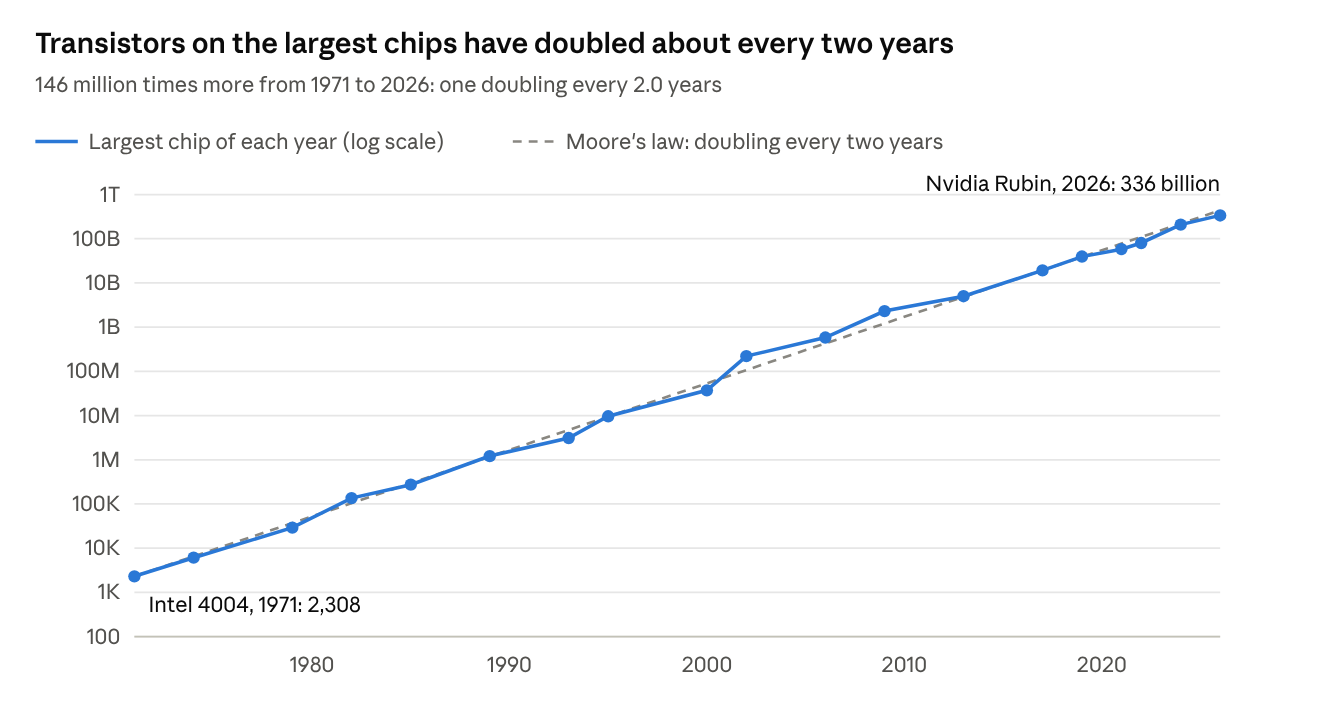
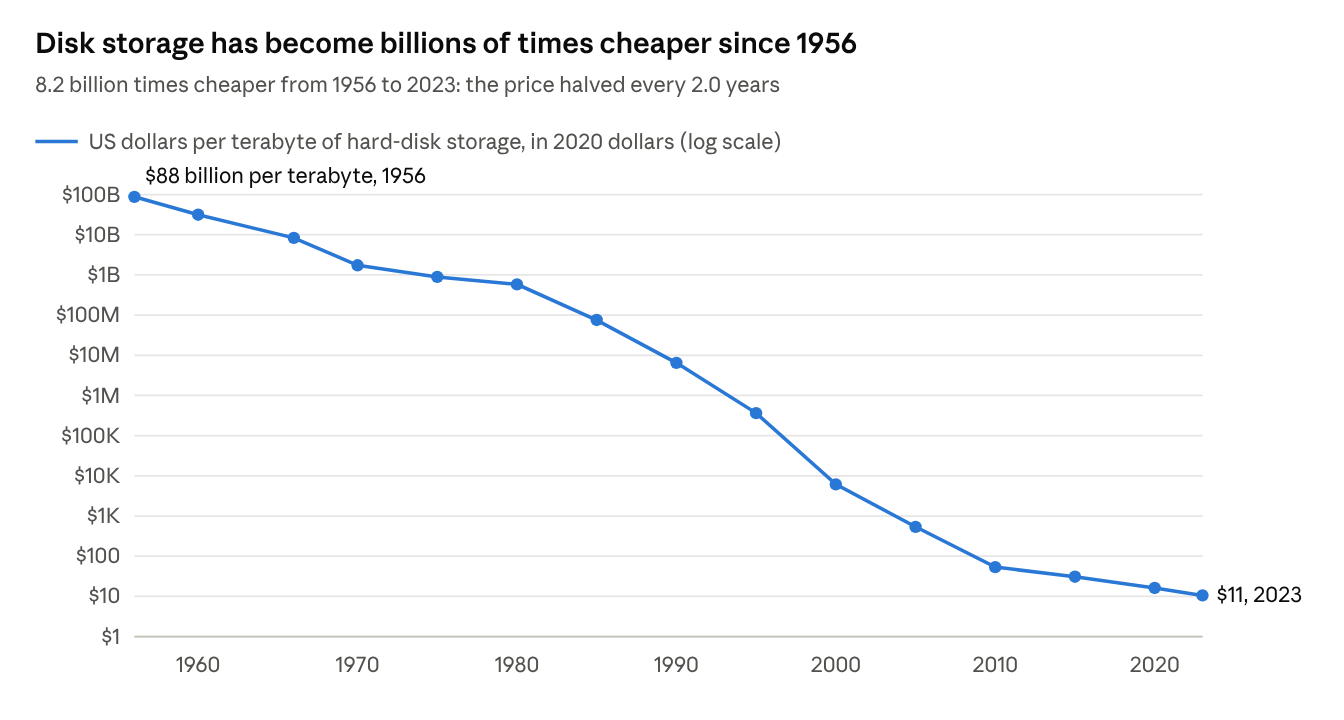
Moore's law has held for half a century: components per chip doubled every year from 1965, then every two years from 1975. Storage followed. The storage in a typical laptop today would have cost about $20 billion in the 1950s.
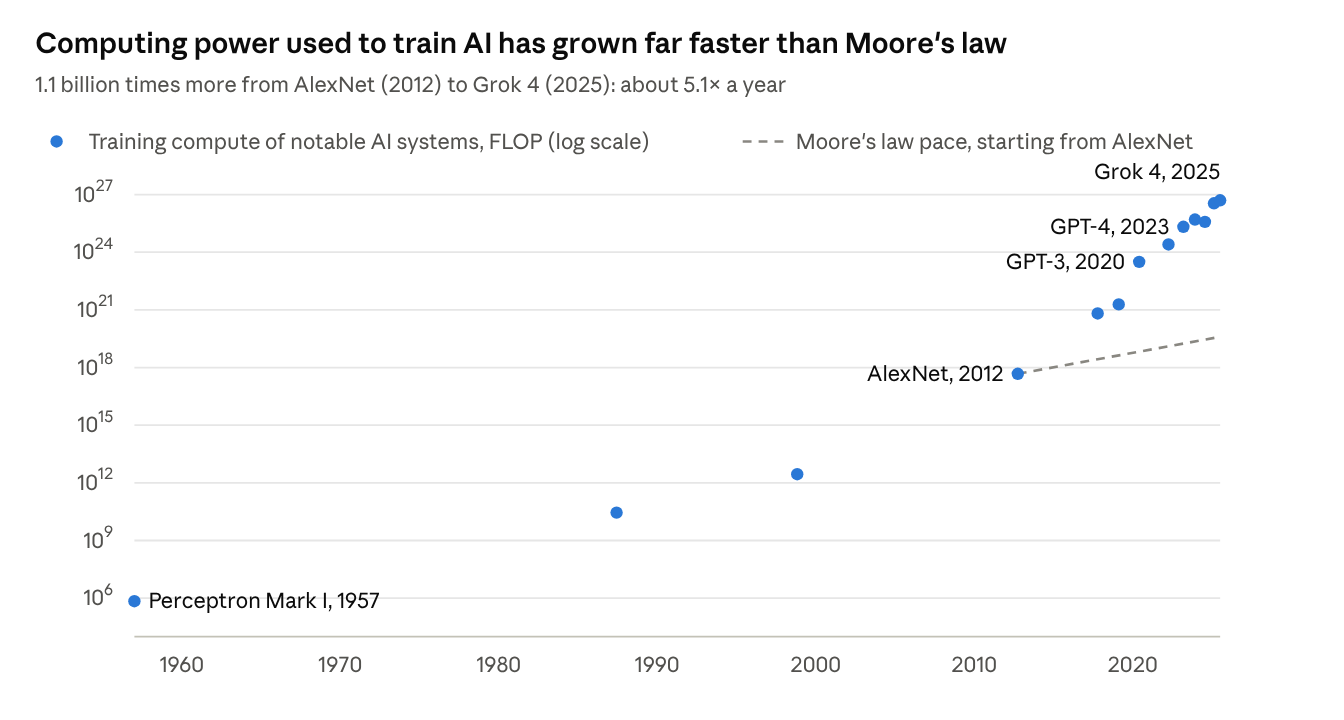
AI runs on a steeper curve. Training compute for notable AI systems tracked Moore's law until about 2010. Since then, Epoch AI estimates it has grown about 4.5x a year, mostly because of bigger budgets, not better hardware. That matters. A curve driven by cheaper chips is hard to stop. A curve driven by spending lasts only as long as someone keeps paying.
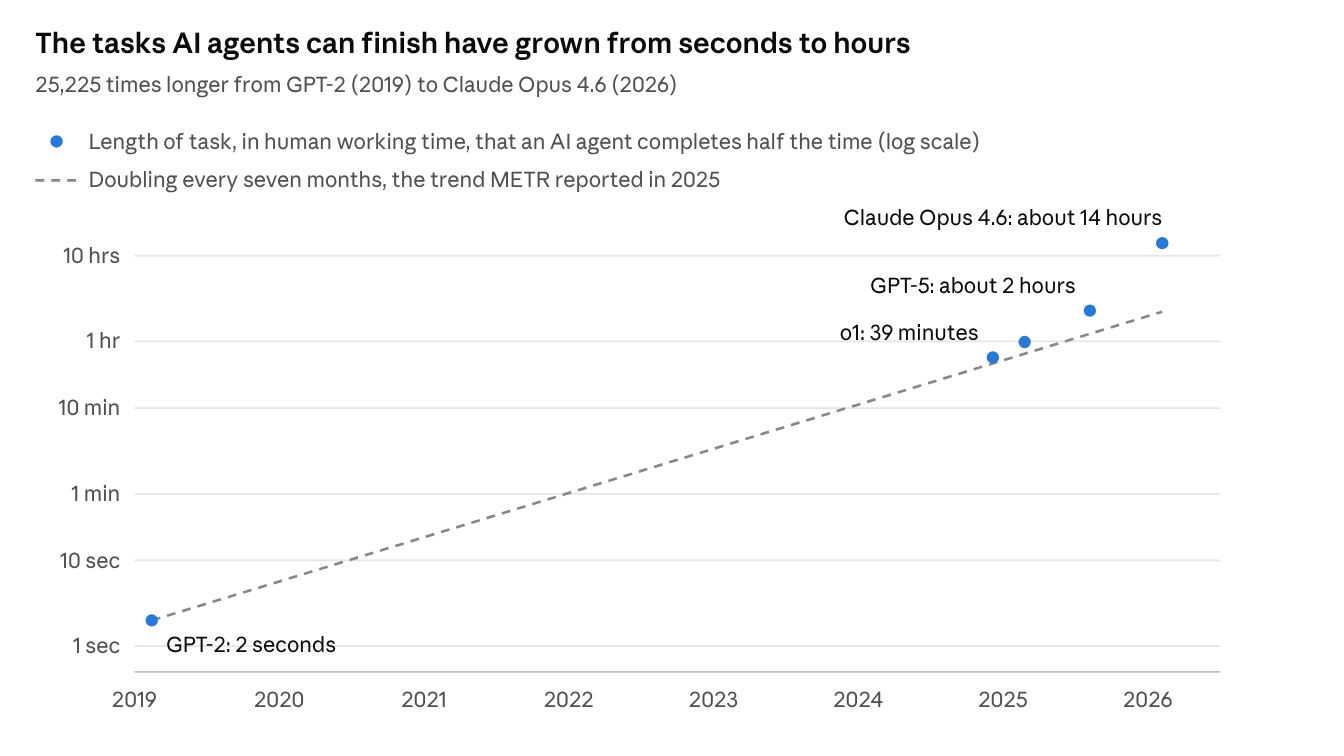
What counts economically is output, not input. METR measures the longest software task an AI agent can complete half the time, timed against skilled humans. That length doubled about every seven months from 2019 to 2025, and the newest models have run ahead of the trend. It has gone from seconds to most of a working day. METR cautioned that its tasks are mostly software and that readings above about 16 hours are unreliable.
The loop, measured
A third driver would be harder to stop than chips or budgets: AI doing the research that improves AI. In November 2026 METR published an eleven-week assessment of exactly that inside Anthropic.
Anthropic is likely improving its models on well-specified tasks at about 1.9x its 2024–25 rate: two years of progress in one.
About 80% of the acceleration came from the lab's own heavy use of AI in research, not from faster growth in compute.
METR found no convincing bottleneck in algorithms, compute, or data over the next twelve months, and warned of "a significant risk" of further acceleration.
The caveats are large, and METR states them. It covers one company; across all frontier developers the speedup was about 1.4x. Different methods put it anywhere from 1.1x to 2.9x. Much of the key evidence was redacted. The gains are on narrow benchmark tasks.
Doubling the pace of progress falls short of an explosion. But it matches what the early stage of a slow takeoff would look like from inside. The mechanism is Good's. The extra speed came from machines improving machines, not from more money.
How fast is fast?
Takeoff speed decides whether history is a useful guide at all.
| Takeoff | Human-level to far-beyond-human AI | What it allows |
|---|---|---|
| Slow | Decades or centuries | Institutions adapt |
| Moderate | Months or years | Time to notice, not to prepare |
| Fast | Minutes, hours, or days | No response |
Paul Christiano gave "slow" a testable meaning: a complete four-year doubling of world output before the first one-year doubling. That means growth climbing from about 3% a year to nearly 20% before anything more dramatic happens. Even a slow takeoff, on this definition, is the fastest economic change in history.
The case for fast. Copies are cheap: a system that can do an AI researcher's job can be run millions of times over. The loop is mostly digital. Each gain makes the next cheaper to find. Tom Davidson's 2023 model put the path from AI doing 20% of economically valuable tasks to 100% at about three years, and from human-level AI to superintelligence at one to twelve months.
The case for slow. Intelligence cannot speed up everything. Chips need fabs and data centers need power, both years to build. Experiments need compute. Most of the economy moves atoms, not bits. Institutions adopt at human speed. Economists call the result Baumol's cost disease: when one sector gets vastly more productive, spending shifts to the sectors that did not, and growth is capped by the slowest essential tasks. Aghion, Jones, and Jones (2017) argued this could keep growth from exploding even if AI automates most tasks.
Overestimated now, underestimated later
Amara's law: we overestimate a technology's effect in the short run and underestimate it in the long run. Gartner's hype cycle draws the same shape, from inflated expectations through a trough of disillusionment to a plateau of productivity.
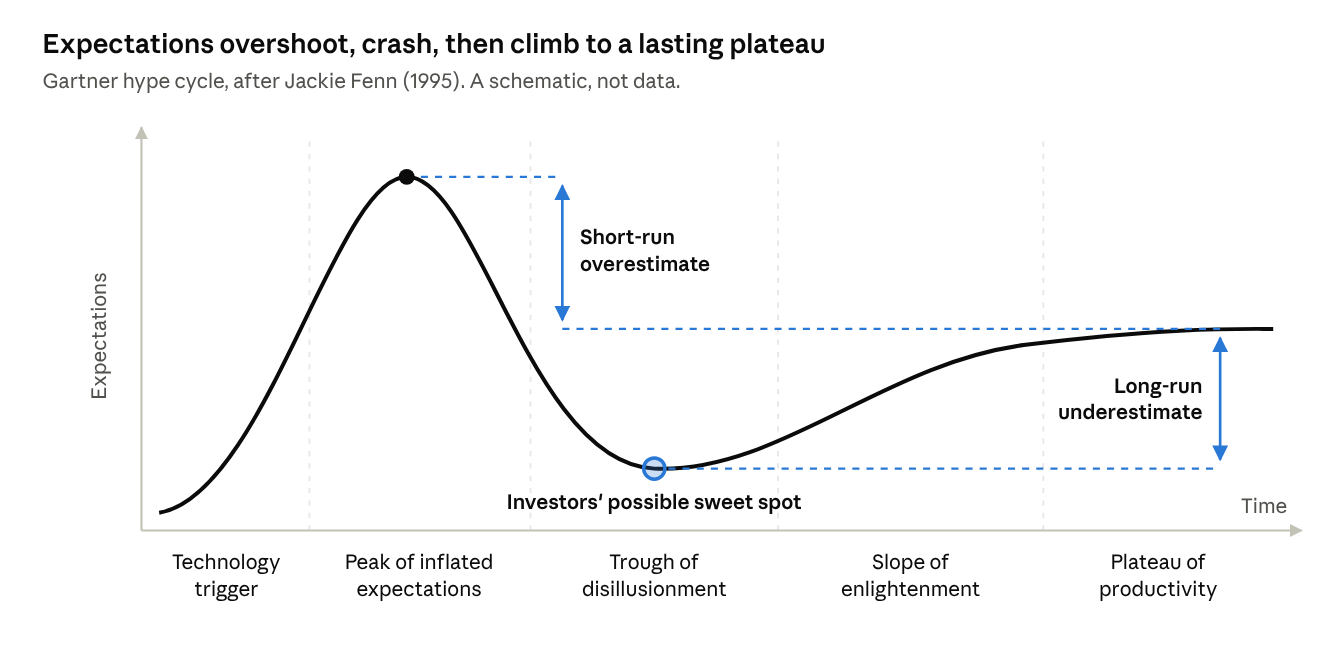
The trough looks like the investor's sweet spot. It is a weak one. When The Economist traced breakthrough technologies through Gartner's charts in 2024, only about a fifth followed the full cycle, and about three in five that fell into the trough never climbed out. And a technology can win while the companies selling it lose.
A slow takeoff would preserve the curve: a visible peak, a trough, years to buy disappointment. A fast one could compress the whole cycle into months, or skip the trough. The open question is whether AI is riding a familiar hype cycle, or whether the singularity is the point at which the long run arrives early.
II. The Valuation Problem
A stock is worth its future cash flows, discounted to today. The singularity attacks both halves of that sum: it changes whose cash flows grow, and it should raise the rate at which all of them are discounted.
The numerator: whose cash flows?
For most of the postwar period, US nonfarm business paid workers a steady 60–66% of output. After 2000 the share began to fall. In Q2 2026 it reached 52.8%, the lowest since the Bureau of Labor Statistics began measuring in 1947. Globalization, dominant firms, cheaper equipment, and automation all contributed. The singularity would push the same lever much harder: if machines do the work, labor's income goes to whoever owns the machines.
Anton Korinek and Donghyun Suh model this as a race between automation and capital accumulation. If automation is slow, there is always work left for people and wages keep rising. If it reaches every task, wages eventually collapse, whatever savers do. In between, wages rise first, then fall.
That sounds like good news for shareholders, but there is a catch. A world where capital takes all is not a world where your capital takes all. The income could go to a handful of firms, to the owners of energy and land, or through taxes to the state.
The denominator: what discount rate?
Theory ties the real interest rate to expected growth. If people expect to be far richer tomorrow, they save less today, and borrowing gets dearer. The same happens if they fear there may be no tomorrow.
In 2023 Trevor Chow, Basil Halperin, and J. Zachary Mazlish used this to test whether markets believed in transformative AI. Aligned AI would raise real rates through explosive growth. Unaligned AI would raise them through extinction risk. In their simplest case, moving from 2% to 30% growth lifts the real rate from about 3% to 31%. At the end of 2022 the 30-year US real rate was 1.6%. Their conclusion: either markets did not expect transformative AI within 30 to 50 years, or markets were badly wrong.
Since then, real rates have moved. In August 2026, 30-year TIPS sold at a 2.973% real yield, the highest at auction since October 2001. Deficits and post-pandemic inflation are plausible causes too. But the bond market is one of the few places the singularity would announce itself in a number.
Higher real rates hurt assets whose value lies furthest in the future: growth stocks, long bonds, speculative ventures. Those are the obvious ways to bet on AI. You can be right about the technology and still lose money, because the force that lifts the cash flows also lifts the discount rate.
Most of the value lies past the horizon
Take an ordinary company growing cash flows 3% a year, discounted at 8%.
| Years of cash flow | Share of today's value |
|---|---|
| Years 1–10 | ~40% |
| Years 11 onward | ~60% |
| Years 21 onward | ~40% |
For a young, fast-growing company, nearly all of the value is terminal value. If Vinge is right that the world past the singularity cannot be forecast, then most of the value of most assets sits in the part of the future no one can see. Every stock price is an implicit bet on it, whether the holder thinks about the singularity or not.
Frank Knight drew the distinction in 1921. Risk has known odds and can be insured. Uncertainty has no known odds and cannot be priced. Keynes, on prices twenty years out: "We simply do not know." The singularity is Knightian uncertainty in its purest form. The investor's task is not to forecast what lies past the horizon. It is to survive the fact that no one can.
Five questions
If machines replace most paid labor, does income shift from wages to capital?
If growth accelerates, do real rates rise, and what happens to long-duration assets?
If intelligence becomes cheap, what stays scarce?
If the builders do not capture most of the value, who does, and whose profits does it take?
If none of this can be forecast, how should we invest anyway?
III. The Builders Rarely Keep It
Two hundred years of technological revolutions point to one result. The builders create enormous value and keep very little of it. The surplus goes to users, and the profits that remain migrate to whatever stays scarce.
Five surges
Carlota Perez (2002) identifies five great surges since 1771, each roughly half a century long, each set off by a breakthrough that made a key input dramatically cheaper.
| Surge | Big-bang event | Cheap new input |
|---|---|---|
| Industrial Revolution | Arkwright's mill, 1771 | Mechanized cotton spinning |
| Steam and railways | Liverpool–Manchester trial, 1829 | Coal, steam transport |
| Steel, electricity, heavy engineering | Carnegie's Bessemer plant, 1875 | Steel, electricity |
| Oil, automobiles, mass production | Ford Model T, 1908 | Oil, mass-produced vehicles |
| Information and telecommunications | Intel microprocessor, 1971 | Microelectronics |
Each surge splits into two halves of 20 to 30 years with a crash between them, and each phase rewards a different kind of capital.
| Phase | What happens | What tends to pay |
|---|---|---|
| Irruption | New technologies appear | Early venture bets, mostly lost, a few spectacular |
| Frenzy | Capital floods in; prices outrun profits | Selling to the crowd; picks and shovels |
| Turning point | Crash, recession, reform | Cash and patience; buying survivors cheaply |
| Synergy | Technology spreads across the economy | Broad ownership; businesses that use the technology |
| Maturity | Markets saturate; returns fade | Income, value, caution |
The bubble is how the infrastructure gets paid for. Railway Mania investors lost much of their money, and Britain got its network. Dot-com investors lost most of theirs, and the world got its fiber.
Where does AI sit? Perez argues it is not a sixth surge but the third leap inside the information revolution, after the microprocessor and the internet: "a revolutionary technology is not the same thing as a technological revolution." If so, AI arrives in the long-delayed deployment period, and the adopters matter more than the builders. The other reading treats AI as the irruption of a sixth surge, with a frenzy and crash still ahead. A third possibility: Perez's rhythm is set by how fast people and institutions change. A technology that can design, decide, and adapt may not wait for them.
Builders and keepers
The same pattern repeats in every revolution.
Railways. British track nearly tripled from 2,240 to 6,621 miles in 1844–50, while revenue per mile fell from £3,470 to £2,080 against about £35,000 to build each mile. In the US Panic of 1893, about a quarter of rail mileage went into receivership. The winners were farmers, manufacturers, mail-order retailers, landowners near the lines, and the bankers who bought the wreckage.
Electricity. Pearl Street opened in 1882. Utilities were regulated as monopolies with capped returns. US factory productivity did not surge until the 1920s, about four decades later, when factories were rebuilt around electric motors. Manufacturing productivity then grew more than 5% a year.
Cars and planes. At least 2,000 American car makes became three. About 300 aviation companies were founded between 1919 and 1939. By Warren Buffett's 1999 count, the cumulative profit of all US airlines since Kitty Hawk was "zero. Absolutely zero."
The internet. By mid-2002 only 2–5% of US fiber was lit. Telecom firms were more than a quarter of US corporate bond defaults by value in 2001. The cable was sold cheaply and carried the modern internet for companies that never paid to lay it.
The keepers had two things in common: they bought after the crash, and they controlled something that stayed scarce. That might be customers, land, a resource, or a standard everyone had to use.
The surplus goes to users
William Nordhaus measured how much innovators actually keep. Using US nonfarm business data for 1948–2001, he estimated that innovators captured about 2.2% of the social value of their innovations. The rest, about 98%, went to everyone else as lower prices and better products. Innovators' profits eroded at about 20% a year as competitors copied them.
The reason is that ideas are non-rival (Paul Romer). A machine can be fenced off. An idea, once known, spreads.
The largest gains often never show up in profits or GDP. In 1800, 1,000 lumen-hours of light cost more than five hours of work. By 1992 it cost less than half a second. Price indexes tracked candles and bulbs, not light, and missed most of the gain. Today the average person would need $17,530 a year to give up search engines and $8,414 to give up email (Brynjolfsson et al., 2019). Search is among the most profitable businesses ever built, and its users still keep most of the value.
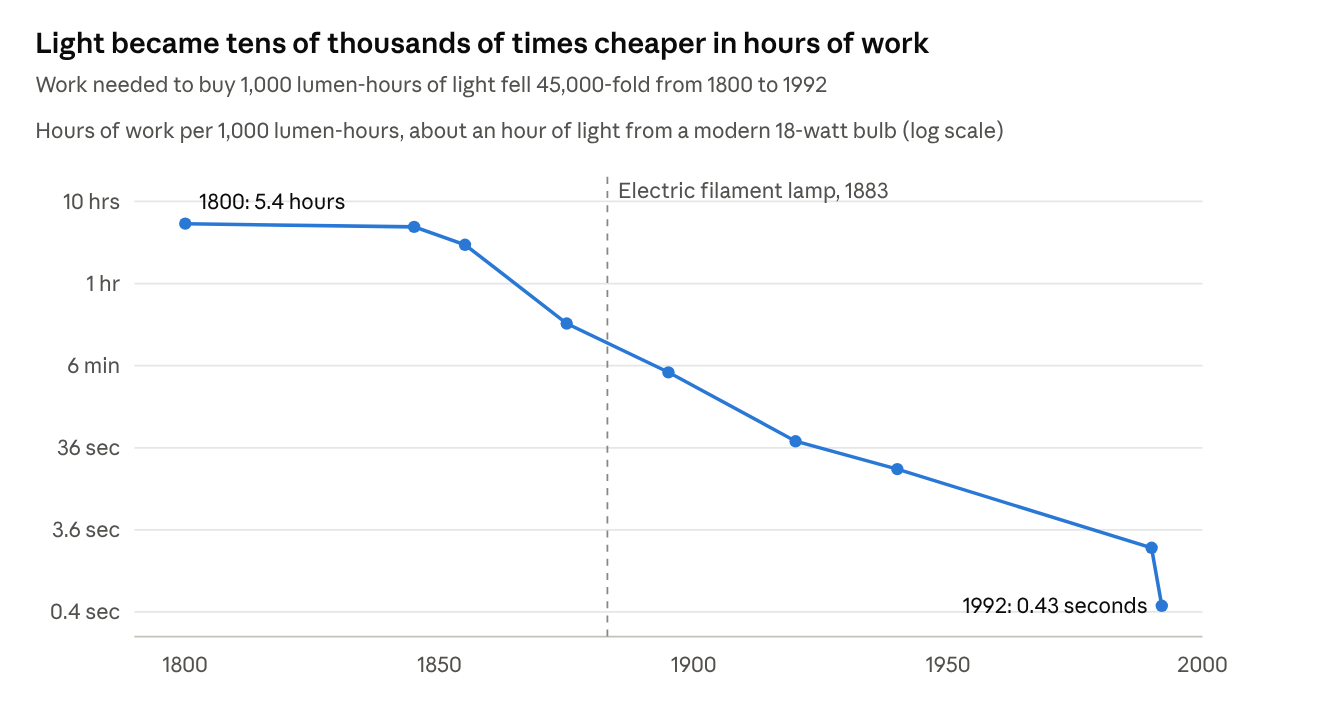
AI may be the most extreme case yet. Its product is cognitive work, and the cost of a fixed level of performance is falling 9x to 900x a year depending on the task; matching GPT-4 on PhD-level science questions got about 40x cheaper each year. Three implications follow:
Value created is not value captured. The size of the AI opportunity says little about returns to AI companies.
The gains may be hard to see. They may show up as lower prices, not higher profits or GDP.
Falling prices hurt sellers. Anyone selling cognitive work at today's prices is exposed.
Where profits move
Clayton Christensen's law of conservation of attractive profits explains the exceptions. When a product is not yet good enough, integrated designs win and earn high margins. Once it overshoots what customers need, the industry breaks into modules with standard interfaces, and those modules compete on price. Profits do not vanish. They move to the stage that is still holding back performance.
The PC. IBM built the defining product of 1981 from outside parts and let Microsoft license its operating system to others. PC assembly became a commodity. Profits went to Intel and Microsoft. IBM sold its PC business to Lenovo in 2005.
The smartphone. While phones were not yet good enough, integration won. In Q2 2018 Apple took an estimated 62% of global smartphone profits while selling a minority of the phones.
In AI the chain runs from energy and land, to chips, data centers, models, applications, and customers. Today the profits sit in chips, the stage furthest from good enough. In the quarter to July 2026, Nvidia reported $96.2 billion of revenue, $89.0 billion of it from data centers, at a 75% gross margin, more than double a year earlier.
The market has already tested the fear of commoditization. When DeepSeek claimed in January 2025 to have trained a competitive model on about one-eleventh of Meta's compute, Nvidia lost nearly 17%, about $589 billion, in one day, the largest one-day loss for any company. The fear was premature: cheaper intelligence led to far more use of it, and Nvidia's revenue doubled the next year.
If the law holds, profits will not stay in chips. The candidates for the next bottleneck:
Down the chain: electricity, grid connections, sites, advanced memory, and packaging.
The frontier models: if AI research accelerates, the leaders may pull away; if open models become good enough, model-making becomes PC assembly. That is what I saw in Shanghai: the free models are close behind.
Up the chain: standard interfaces already let customers switch models in a few lines of code, which shifts value toward whoever owns the customer, the data, and the workflow.
Across the chain: integrated players betting that owning several stages captures profits wherever they land.
IBM controlled the most important stage of computing for decades. Its profits still moved away.
IV. What the Record Shows
Owning a broad slice of the economy through every technological revolution paid well. Buying the revolution's favorite stocks at the height of the excitement did not. The infrastructure layer lagged the market every time.
The long view
The Dimson–Marsh–Staunton data (UBS Global Investment Returns Yearbook 2026) cover 1900–2025. Real annual returns: US equities 6.6%, US government bonds 1.6%, gold about 1.3%. Jordà, Knoll, Kuvshinov, Schularick, and Taylor ("The Rate of Return on Everything") cover 16 economies from 1870: housing and equities each earned roughly 7% real, and housing did it with about half the volatility.
Those 125–150 years include three of Perez's five surges, two world wars, a depression, and several inflations. The averages already contain every boom and bust. But no one lives through an average.
The frenzies and their crashes
| Frenzy | Index | Peak | Trough | Fall |
|---|---|---|---|---|
| Dot-com | Nasdaq Composite | 5,048.62, Mar 10, 2000 | 1,114.11, Oct 9, 2002 | 78% |
| Roaring Twenties (cars, radio, electricity) | Dow Jones Industrial Average | 381.17, Sep 3, 1929 | 41.22, Jul 8, 1932 | 89% |
| British Railway Mania | Railway share index | 167.9, summer 1845 | 60.5, end of 1849 | 64% |
The length mattered more than the depth. The Dow did not close above its 1929 peak until November 1954, 25 years later. The Nasdaq took 15 years, to April 2015. Through both waits, the technology kept spreading. The revolution did not fail. The price paid at the top did.
Two qualifications. Dividends kept flowing: the Dow's yield was close to 14% at the 1932 low, and on a total-return, inflation-adjusted basis a 1929 buyer was whole less than four and a half years after the low. And not every frenzy ended badly: Britain's smaller 1830s railway mania crashed, recovered, and beat the market, which is exactly what lured buyers into the 1840s.
Most leaders disappeared
Cars: 253 US manufacturers in 1908, 44 in 1929, fewer than a dozen by 1939.
Internet: of the 50 largest Nasdaq stocks in March 2000, only 29 still existed fifteen years later, and only 10 of those traded above their 2000 price.
Yet railroads, which dominated the US market in 1900 and are now under 1% of it, beat the market over the long run. A shrinking industry bought cheaply that pays out its cash can be a good investment. A growing one bought dearly that burns cash can be a bad one.
Hendrik Bessembinder studied nearly 26,000 US stocks from 1926 to 2016. 58% failed to beat one-month Treasury bills over their lifetimes. Just 1,092 companies, about 4%, created all of the market's net wealth.
A scorecard by layer
Stories can be chosen to fit a thesis. A sterner test sorts the whole market by industry using Kenneth French's 49 value-weighted industry portfolios since 1926, through two complete revolutions, into three layers: the infrastructure that carries a technology, the builders who make its products, and an adopter, retail, that used it to sell more cheaply.
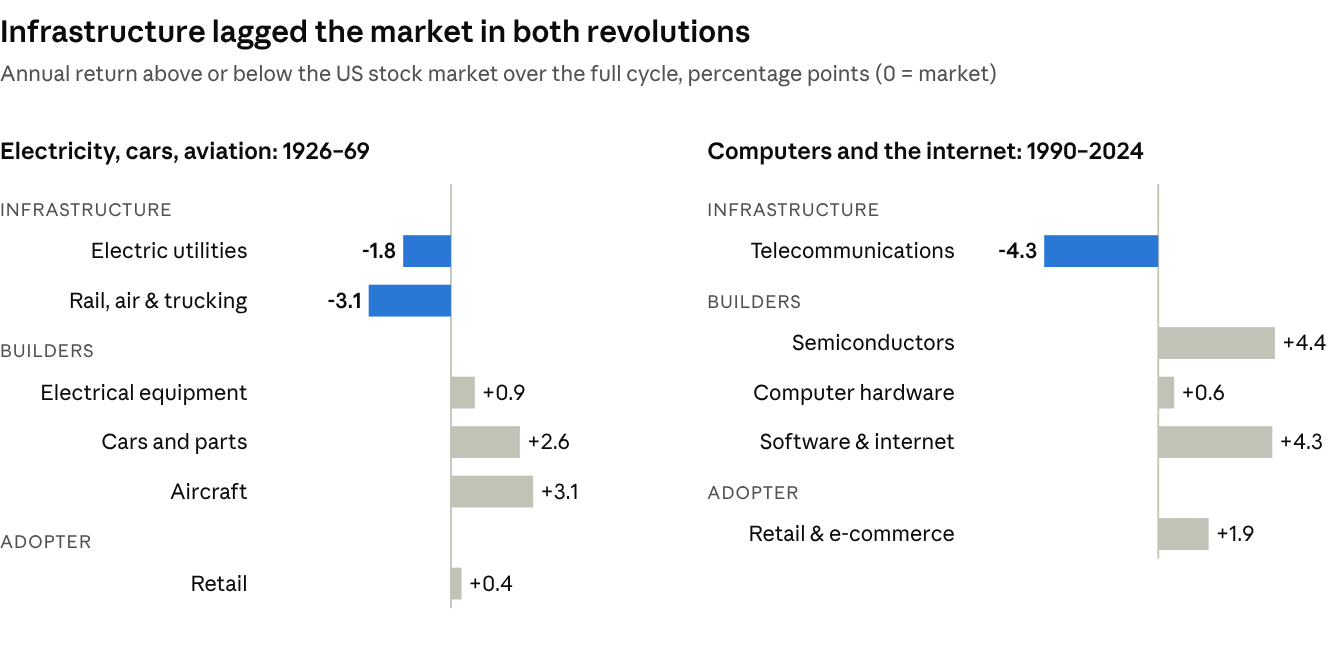
Infrastructure lost, every time. Utilities trailed the market by 1.8 points a year over 1926–69, transport by 3.1, telecom by 4.3 over 1990–2024. A telecom holder from the 2000 peak ended 2024 with about a quarter of what the market earned. Over all 98 years, utilities, telecom, and transport all lagged.
Builders were fine on average, but the entry price decided everything. Aircraft beat the market by almost 60 points a year in the late-1920s mania, then trailed it for two decades. Chips trailed by 10 points a year from March 2000 to 2012. Over 1926–2024 as a whole, hardware beat the market by 1.9 points a year, chips 1.1, aircraft 2.1, cars 0.7.
Adopters gained steadily. Retail lagged in both frenzies, then beat the market after both peaks, by 1.8 points a year after 1929 and 3.7 after 2000, with much smaller swings.
After each peak, the unloved did best. From March 2000 to 2012, oil beat the market by 9.3 points a year, utilities by 7.2, chemicals by 7.1.
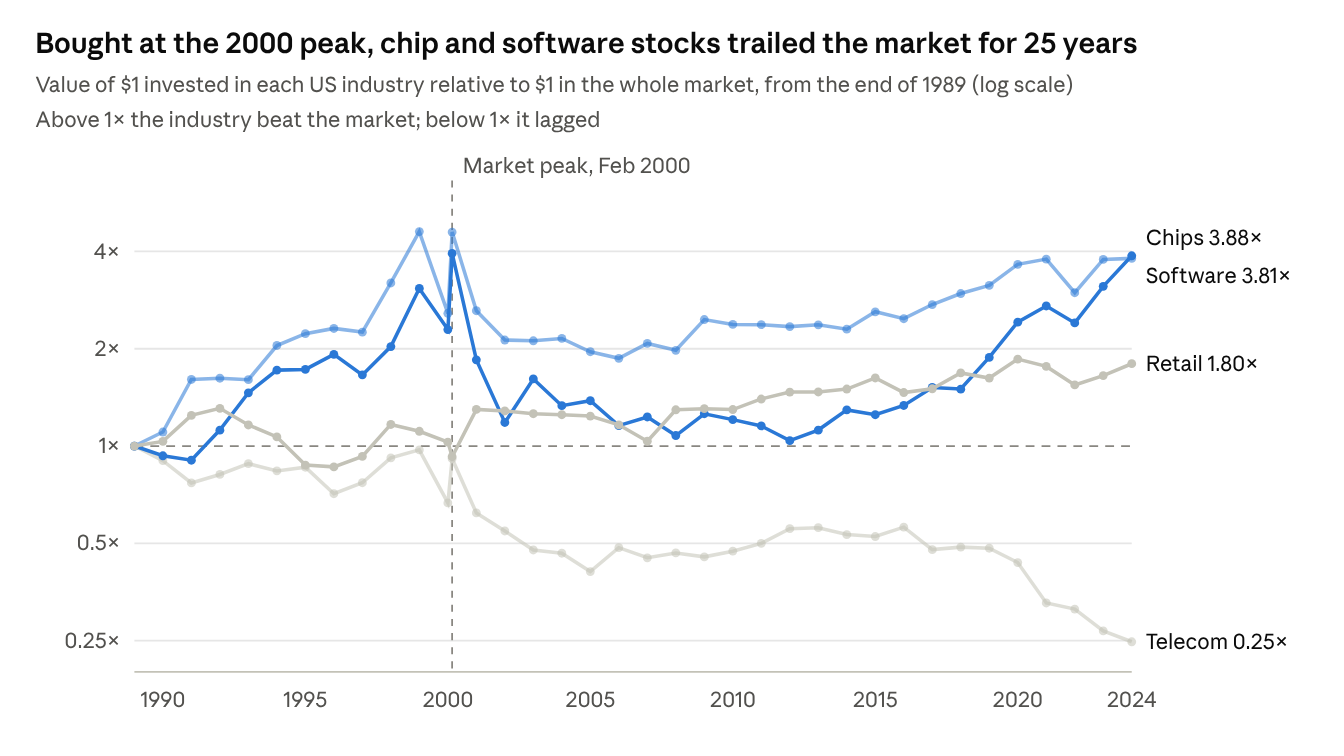
The data are US only, end in December 2024, and before 1962 include only NYSE stocks, which flatters the builders by omitting failures. By the end of 2024, chip stocks had beaten the market by 13.3 points a year for twelve years, the same shape they showed in the late 1990s. That proves nothing about what comes next. It does mean the answer depends on the price.
The safe assets were not safe
Real returns on safe assets have been about as volatile over the long run as returns on risky ones. Real safe rates fell well below zero in both world wars and in the 1970s. A 10-year Treasury investor had lost about 40% in real terms by the early 1980s, at the start of the microprocessor surge. Then came a four-decade bond bull market. Bonds do not hedge technological change. They are a bet on inflation and rates, which technology influences but does not determine.
Land did better. Housing matched equities before the Second World War, beat them on a risk-adjusted basis throughout, and was only loosely correlated with stocks. Each revolution made something cheap and something else scarce. Railways and cars made distance cheap, and land near the new lines and roads became the bottleneck.
Four lessons
Broad ownership captured the revolution, through every crash.
The entry price decided the outcome. Buyers in 1932 and 2002 won; buyers in 1929 and 2000 lost.
Most leading companies disappeared. Picking winners early was close to a lottery, and infrastructure earned least of all.
The safe assets were not safe. Real assets on the new bottlenecks did better.
V. Scarcity After Abundance
When intelligence becomes cheap, the price of everything that depends on it falls. What stays expensive is whatever intelligence cannot make more of: atoms, permission, position, and people.
When labor becomes capital
Every growth model starts with capital, labor, and technology. For two centuries labor was the scarce input. Advanced AI erases the distinction: if a data center can do the work of a lawyer or a programmer, labor becomes something you can manufacture. Output then depends on how much compute, energy, and equipment a society owns.
Philip Trammell and Anton Korinek survey what standard models predict, and the range is wide: a one-time boost, a permanently higher growth rate, or growth that keeps accelerating until land and energy cap it. Wages could rise or collapse. The skeptics' numbers are far smaller. Daron Acemoglu (2024) estimated AI would add "no more than a 0.66%" to total factor productivity over ten years. US labor productivity grew 2.2% in the year to Q2 2026, close to its long-run average. So far, the numbers are ordinary.
Four futures, not mutually exclusive:
| Future | Growth | Wages | Real rates | Who gains most |
|---|---|---|---|---|
| Explosive growth | Far above history | Could rise or fall | Sharply higher | Owners of scarce inputs; long bonds lose |
| Baumol's drag | Moderately higher | Rise for hard-to-automate work | Somewhat higher | Human services; bottleneck assets |
| Capital takes all | Strong | Stagnate or fall | Higher | Owners of AI and the resources it uses |
| Redistribution | Depends on policy | Supported by transfers | Depends on financing | Broad population; capital keeps less after tax |
Note the real-rate column. The future most investors hope for is not obviously good for the assets they hold.
And note who owns the capital. In Q2 2026 the top 10% of US households held 88% of household equities, the top 1% held 51%, and the bottom half held 0.6%. A shift that large toward capital would be politically unstable. An investor betting on capital-takes-all should expect redistribution to follow. One concrete proposal already exists: Sam Altman's 2021 American Equity Fund, financed by an annual 2.5% levy on the value of large companies and of private land.
The great divergence in prices
The split is already visible. Over 25 years, things made in factories got cheaper. Things that need people, land, or permission got dearer.
| Item | US price change, 2000–2025 |
|---|---|
| Hospital services | +275% |
| College tuition and fees | +196% |
| Housing | +111% |
| All items | +92% |
| New and used vehicles | +25% |
| Televisions | −98% |
William Baumol explained why. A string quartet needs the same four players and the same time as in Beethoven's day, but must pay wages that keep up with factory workers. So services that resist automation get steadily dearer. AI moves writing, analysis, diagnosis, coding, and design to the cheap side of the line. Whatever stays hard to automate will claim a larger share of spending.
The bottlenecks
Energy and the grid. The IEA projects data-center electricity use rising from about 415 TWh in 2024 to about 945 TWh by 2030. At the end of 2025, 2,061 GW of proposed generation and storage waited to connect to the US grid. The typical project took more than five years. Of capacity that applied in 2000–2020, only 13% had come online, and 75% had been withdrawn. A data center can be designed in an afternoon. Powering it can take most of a decade.
Chips. TSMC held a record 70.2% of global foundry revenue in Q2 2025. Its leading fabs depend on one Dutch supplier, ASML, for EUV lithography. Much of the capacity sits on one island in a contested region.
Land and fixed resources. David Ricardo saw that as an economy grows, owners of the one input that cannot expand collect a rising share. Trammell and Korinek find the same in AI models: when a fixed resource binds, its owners can capture nearly all output. Today "land" means sites with grid connections and water, minerals like copper, and permits to build. Chile's Escondido shows how slowly the first of those expands: a new deposit takes years to find and more years to bring into production.
Positional goods. Fred Hirsch's term (1976) for things valued by relative rank: the best school district, the beachfront, the top university place. Productivity cannot multiply them, and abundance tends to raise their price.
The human premium. Machines have beaten the world chess champion since 1997, yet the number of active professional players nearly doubled from 2009 to 2014. Some work is valued because a person did it. Some requires a person to answer for it: a doctor's signature, a lawyer's advice. Licenses protect these roles, though rules written by people can be rewritten.
Attention and trust. Herbert Simon (1971): "a wealth of information creates a poverty of attention." AI multiplies content without limit. Attention does not grow. When options are infinite, value moves to trusted brands, reputations, customer relationships, and distribution.
Scarcity is not a guarantee
Scarcity everyone can see is usually already in the price. By late 2026 the market had plainly noticed chips and power. High prices call forth new supply; the fiber glut of 2001 shows what happens when everyone builds for the same shortage. How fast supply arrives is the whole question. Fiber could be laid in a few years. A copper mine cannot. And AI may relieve some constraints itself, through better chip design, new materials, or smarter grids.
None of this is a list of things to buy. When the price of thinking falls toward zero, ask what still requires atoms, permission, position, or a person. Then ask how durable that advantage is, and what you are paying for it.
VI. The Other Side of the Ledger
The value of a revolution has to come from somewhere. When intelligence becomes cheap, the businesses most exposed are those that sell it. They will look cheapest on every traditional measure right up until the earnings that made them look cheap disappear.
The repricing has started
| Date | What happened |
|---|---|
| Feb 2026 | After Anthropic released plug-ins letting its Claude Cowork agent automate legal, sales, marketing, and data work, the S&P 500 software and services index fell nearly 13% in five sessions while the broad index hit a record. Thomson Reuters fell 16%, its worst day on record. Data publishers, ad agencies, Indian and Japanese IT services, and private lenders to software sold off together. |
| Feb 2024 | Klarna said its AI assistant handled two-thirds of customer-service chats, the work of 700 people. Teleperformance, the largest call-center operator, fell 29% in a week. |
| 2023–2026 | Chegg, worth about $14.5 billion in 2021, fell 48% in a day in May 2023 after citing ChatGPT. By Q1 2025 subscribers were down 31% and revenue 30% year on year. By April 2026 the shares were about 99% below their peak, after a $300 million buyback. |
The last revolution ran the same play. US newspaper ad revenue fell from about $49 billion in 2005 to under $10 billion by 2020. Newspaper stocks looked cheap on earnings and paid generous dividends throughout. Baruch Lev and Anup Srivastava (2019) found value investing had been losing potency since the late 1980s, partly because old-economy firms lacked the means to invest in new technology. In a revolution, a low price can mean a permanent loss of earning power, not a temporary loss of confidence. This is the Tokyo lesson. On a balance sheet, endurance and obstinacy look the same.
Who is exposed
The common feature: selling cognitive work, or access to it, at prices set when that work required people.
| Business | What AI does to it | What may protect it |
|---|---|---|
| IT services and outsourcing | Does the billable hours; clients pay for outcomes, not heads | Deep client relationships; regulated work |
| Call centers and back office | Agents handle routine work at a fraction of the cost | Complex, regulated, high-trust cases |
| Per-seat software | Fewer human users; agents work around the interface | System of record, proprietary data, switching costs |
| Information and data publishers | AI summarizes and answers directly | Proprietary data, liability, embedded workflows |
| Homework help and test prep | Free AI gives the same answers | Little |
| Advertising and creative agencies | Content at near-zero cost | Client relationships, media-buying scale |
| Professional services | Fewer hours per job | Licenses, accountability, trust |
This is a map of exposure, not a list of doomed companies. But Nordhaus points to the base case: when a technology cuts the cost of producing something, most of the saving goes to customers.
The arithmetic of a melting franchise
If a company pays out all its earnings and they grow at a steady rate forever, its fair P/E is 1 ÷ (required return − growth). At a 9% required return:
| Earnings growth, forever | Fair P/E (next year's earnings) |
|---|---|
| +3% | 16.7 |
| 0% | 11.1 |
| −5% | 7.1 |
| −10% | 5.3 |
| −20% | 3.4 |
A stock at 7x earnings looks like a bargain against a market above 20x. If its earnings shrink 5% a year, 7x is fair. If they shrink 10% a year, it is overpriced by about a third. Nothing in the past earnings or dividends reveals this.
Run the formula backward and it becomes useful: required return minus earnings yield gives the growth the market already assumes. At 6x and 9%, the market is pricing earnings to shrink about 7.7% a year forever. The real question is whether the decline will be faster or slower than the price assumes.
Bargain or melting ice cube?
What does it sell? Cognitive work priced by the hour, head, or seat is exposed. Physical assets, licenses, proprietary data, and trust may be protected.
Who keeps the savings? If AI cuts its customers' costs, competition usually forces it to pass them on.
Is the decline in volume or price? Both at once points to a structural problem.
What is already priced in? A stock priced for a 10% annual decline can be a bargain if the business shrinks more slowly.
Can the balance sheet survive? Debt turns a slowly shrinking business into a bankrupt one.
What is management doing with the cash? Buybacks in a vanishing business destroy value however cheap the shares look.
Question four matters most because markets overreact to fear as they do to hope. In February 2026 investors sold software, legal publishers, data providers, agencies, IT firms, and private lenders together, on the same news. They are not equally exposed. After the 2000 peak, the old economy the mania ignored beat the market by seven to nine points a year. The opportunity lies in the businesses sold alongside the losers that own something AI cannot copy.
If the economic singularity arrives, far more of today's franchises will turn out to rest on the scarcity of human thought, and cheapness will be a poorer guide than ever. If it arrives slowly, the panic of the mid-2020s may look like the indiscriminate selling of 1999. A value investor does not need to know which. The investor needs to know, company by company, what the price already assumes.
VII. Investing Without a Map
No portfolio can be optimized for a future no one can see. But seven principles held through every past revolution, and none of them depends on forecasting this one. These are general principles, not personal advice.
1. Own the economy, not just the builders
Innovators keep about 2% of what they create. Infrastructure lagged the market in every revolution. Builders paid only when bought at sensible prices. Adopters gained steadily. And 4% of stocks created all of the market's net wealth. When returns come from a handful of extreme winners no one can pick in advance, the surest way to own them is to own nearly everything.
The complication: the index is no longer neutral. The US is 62% of world stock market value, and the ten largest US companies are a bigger share of the market than at any time since 1933, many of them betting heavily on AI. Owning the economy, as distinct from the index, may mean deliberately holding AI's users as well as its builders, other countries as well as the US, and real assets as well as stocks.
2. Mind the price
The same technology rewarded buyers in 1932 and 2002 and punished buyers in 1929 and 2000. Price made the difference, not foresight. In early October 2026 the S&P 500's cyclically adjusted P/E was about 41.6, against a long-run average near 17 and a December 1999 record near 44. A high valuation does not indicate an imminent crash. It does predict lower returns unless the future is extraordinary. Today's prices are a bet that it will be. Valuation discipline matters most when the story is most compelling, which is when it is hardest to keep.
3. Follow the bottleneck, but check its price
Profits move to whatever is still holding back performance: energy, grid connections, advanced chips, land and minerals, positional goods, accountable human work, trust. Hadrian, in Los Angeles, is a bet that factory capacity belongs on that list. But bottlenecks move, and visible scarcity is priced accordingly. A bottleneck is an opportunity only if the price does not assume it lasts forever.
4. Hedge the scenarios, not the forecast
| Future | Tends to hold up | Most at risk |
|---|---|---|
| Explosive growth | Owners of scarce inputs; short-term bonds that reprice | Long bonds and long-duration stocks |
| Baumol's drag | Hard-to-automate services; real assets in bottlenecks | Sellers of cognitive work at today's prices |
| Capital takes all | Broad ownership of companies and AI's inputs | A household's own earning power |
| Redistribution | Assets that are hard to tax or already broadly held | Concentrated, visible pools of capital |
No single asset holds up in every future. One fixed point: in August 2026, 30-year TIPS sold at a real yield of nearly 3%, the highest since 2001. Held to maturity, that return above inflation is locked in whatever happens to growth.
5. Survive the tails
The range of outcomes runs from extraordinary abundance to serious disorder. Staying in the game matters more than maximizing any one scenario. Many of those ruined in 1929 had bought on margin with about 10% down. Avoid borrowing that can force a sale at the wrong moment. Keep enough liquidity to meet obligations without panic selling. Never let one bet, including a bet on AI, grow large enough to end the game.
6. Remember your human capital
For most people, the largest asset is the ability to earn a living, and the singularity may reprice it first. Concentration risk between job and portfolio is an old lesson: at the end of 2000, 62% of Enron's 401(k) assets were in Enron stock. The AI version runs the other way. If your income depends on cognitive work AI may soon do cheaply, your human capital is already short AI. Owning a share of the capital that could replace you offsets part of that. The bottom half of US households owns 0.6% of household stock wealth: the most exposed, with the least hedge. Building skills that complement AI is the other half.
7. Read the dashboard, and expect to be wrong
If the singularity comes, it will show up gradually, then suddenly, in a handful of readings. Several first appeared in the introduction. Change the portfolio when they change, not when the headlines do.
| Indicator | Latest reading | What a singularity would look like |
|---|---|---|
| US labor productivity growth | 2.2%, year to Q2 2026 | Sustained growth well above history |
| Labor share of US business output | 52.8%, Q2 2026, a record low | A steep, continuing fall |
| 30-year real interest rate | 2.973%, Aug 2026 TIPS auction, highest since 2001 | A sharp, sustained rise |
| Pace of AI research | ~1.9x its 2024–25 rate at one lab | Accelerating gains driven by AI itself |
| Price of AI performance | Falling 9x–900x a year by task | Cognitive work priced near the cost of electricity |
| Share of stocks held by top 10% | 88%, Q2 2026 | Rising further, then pressure to redistribute |
Read together, the dashboard in late 2026 shows something real but not yet decisive. The inputs are improving at extraordinary rates. The labor share and real rates are moving the way the dramatic scenarios predict. But productivity, the measure that would show AI transforming the whole economy, has not broken from its historical range. That gap is Amara's law. Whether it closes slowly, quickly, or not at all is the question no one can answer, and every investor has to survive anyway.
Good expected his machine within the twentieth century. Vinge's window closes in 2030. Forecasters of this technology have been early, and then late. Expect to be wrong, and hold a portfolio that survives it.
Do You Wanna Be Right, or Do You Wanna Make Money?
Good called the ultraintelligent machine the last invention. The natural question for investors is whether it is also the last investment: one bet, on the right lab or the right chip, that settles everything after. The record says no.
Every earlier revolution looked like the last word to the people living through it. Each remade the world. None handed the world to the people who built it. Three lessons survived all of them:
The builders rarely keep it. Innovators keep about 2%.
Profits move to whatever stays scarce, and the scarce thing changes.
The price paid decides the outcome. Even the surviving builders rewarded only those who did not overpay, and the infrastructure layer earned least of all.
All three are Buffett's 1999 point in different clothes. Changing the world and making money for investors are different things. The singularity could be the largest change the world has seen, and the investor's job would be the same as it was in 1999: find the competitive advantage, judge how durable it is, and refuse to overpay for it.
The introduction suggested we are now entering the singularity. In November 2026 the readings point two ways at once. The unprecedented signs are real: AI measurably accelerating AI research, agent task lengths going from seconds to most of a working day in seven years, the price of machine intelligence falling by orders of magnitude a year, labor's share at a record low. The familiar signs are just as clear: economy-wide productivity at its historical pace, profits concentrated in the picks and shovels at margins that invite competition, valuations near 1999, and hundreds of billions a year spent on infrastructure in the hope that demand grows into it, as telecom once spent on fiber.
Both can be true. Perez describes a frenzy that installs a real revolution and then crashes, followed by a deployment in which the gains spread. Nothing in that history says the technology at the center of a frenzy is fake. It says the people who pay for the installation are rarely the ones who collect. Whether AI follows that rhythm, or breaks it because it can improve itself faster than institutions adapt, is the question every investor now faces.
The proviso
Good's sentence had a second half that is quoted less often: the machine would be the last invention "provided that the machine is docile enough to tell us how to keep it under control."
That proviso is the one risk no portfolio can hedge. Every principle here assumes property rights hold, markets function, and the future, however strange, still belongs to people. If that fails, diversification and valuation discipline will not matter much. The most important investment of the coming decades may not sit in any brokerage account: the effort to keep the most powerful technology ever built something people can understand, direct, and trust.
The good news in the numbers
If innovators keep only a sliver of what they create, then most of the value of every revolution has gone to everyone else. Light that once cost five hours of work now costs a fraction of a second. If the singularity arrives and that pattern holds, the largest beneficiaries will not be the shareholders of any one company. They will be the people who use what it makes possible.
An investor cannot see past the event horizon. But an investor can own a broad share of the economy on the other side, pay sensible prices for it, avoid the bets that end the game, invest in the skills that stay scarce, and keep reading the dashboard. That is not a map of the future. No one has one. It is a way of standing at the edge with your eyes open.
Sources
The singularity and takeoff. Vinge, 1993 · OpenAI Charter · Nordhaus, "Are We Approaching an Economic Singularity?" · Christiano on takeoff speeds (AI Impacts) · Davidson on takeoff speeds · Amara's law (Quote Investigator) · Gartner hype cycle
AI capability and cost. Epoch AI, training compute · Epoch AI, LLM price trends · METR, task length (2025) · METR time horizons · METR, AI R&D acceleration assessment (Nov 2026) · Our World in Data, storage prices
Macro and valuation. BLS, labor share Q2 2026 · BLS, productivity Q2 2026 · Korinek and Suh · Chow, Halperin, and Mazlish · 30-year TIPS auction, Aug 2026 · Trammell and Korinek · Acemoglu, "The Simple Macroeconomics of AI" · Altman, "Moore's Law for Everything" · Stock ownership by wealth (PennyCalc) · FRED · Shiller CAPE 2026
History of revolutions. Perez, via Wladawsky-Berger · Buffett, Fortune 1999 · Odlyzko, "The Railway Mania" · Odlyzko, "This time is different" · Panic of 1893 · Paul David on electricity · FDIC, 2002 · Nordhaus, innovators' share (NBER Digest) · Price of light (Our World in Data) · Brynjolfsson et al. · Apple smartphone profit share · Nvidia FQ2 2027 results · Nvidia DeepSeek drop
Asset returns. UBS Yearbook 2026 (WealthBriefing) · UBS Yearbook 2025 · The Rate of Return on Everything · INET on safe rates · Federal Reserve History, 1929 · New York Sun, Nasdaq · Hulbert on 1929 total return · DQYDJ, Nasdaq drawdowns · EBSCO, US auto industry · San Francisco Chronicle, Nasdaq 2000 leaders · Bessembinder (ASU) · Motley Fool, bonds · Kenneth R. French Data Library, 49 industry portfolios
Scarcity and disruption. Price changes 2000–2025 · IEA data-center demand · Berkeley Lab interconnection queues · TSMC foundry share · Chess after Deep Blue · Chegg · Teleperformance · Software sell-off, Feb 2026 (Reuters) · Software sell-off (Forbes) · Pew, newspaper revenue · Lev and Srivastava · Enron 401(k)
Read the dashboard every morning.
The Last Investment: the day's AI news for investors, in 47 seconds.